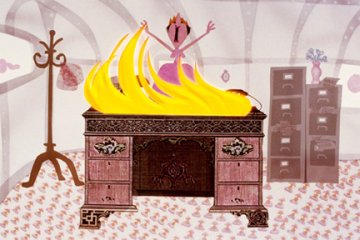
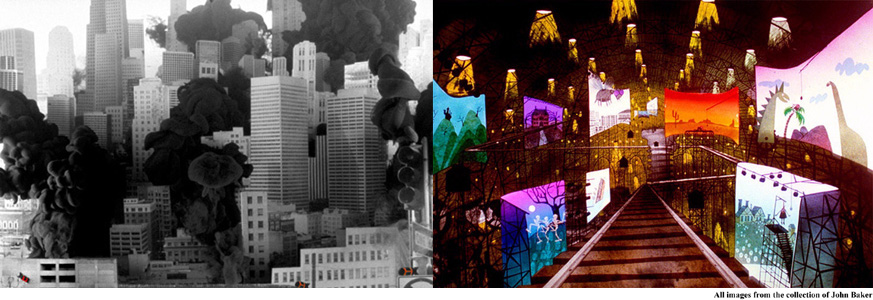
 wo decades ago this month, HBO broadcast an obscure animated film called Twice Upon a Time. As a rule, no film’s pay-television debut deserves a commemoration, but this one was special. It was significant, first, because of the movie itself: a cut-out animated film starring characters made entirely of fabric, with a story told in a hip, ironic style too sophisticated for kids and too silly for adults (or so the studio thought, anyway).
It was significant for the filmmakers, who were suddenly getting an audience of millions for a movie that had opened and closed in two weeks in a single Westwood, California theater in August 1983.
And it was significant for a generation of animators and other smart-ass creative artists (my hand is raised), all of us left gasping at its astonishing visuals and pissing ourselves laughing, our creative outlooks forever changed in its wake.
But it was significant for me and my sister, who stumbled on the film while channel-surfing, because it completely reprogrammed our expectations of what an animated film could be. Here’s one reason why: There’s a scene about two-thirds the way through the film when Botch, the cruel overlord of the Murkworks, where nightmares are made, is confronting Scuzzbopper, the jester-like Head Writer of the Murkworks who’s supposed to be writing all the nightmare scripts but who in his spare time has been writing the Great Amurkian Novel. In this scene, Scuzzbopper comes to Botch’s high castle tower and presents him with his manuscript (3,781 pages, single-spaced). Botch is not impressed. He throws it out the castle window, where it flutters away in the dusk, and he banishes Scuzzbopper from the room, screaming “I WANT NIGHTMARES! READ MY LIPS – NIGHTMARES!” Scuzzbopper forlornly makes his way down the steps out of shot, and as he exits off-screen, you can just hear him mutter under his breath: “Asshole.”
Twice Upon a Time retains a hefty cult following, and those 12 airings on HBO in June 1984 have a lot to do with it. A lucky few channel-surfers stumbled on it, and all of them were hooked - and all of them were damned for it, because for the next seven years, you couldn’t find Twice Upon a Time anywhere, no matter how hard you tried. And when it finally came to home video in 1991, we were in for a small shock.
When we first saw Twice Upon a Time, my sister was fourteen and I was twelve. In the years that followed, character names from the film like “Ralph the All-Purpose Animal” and “Rod Rescueman” and bits of dialogue like “The Big Red One!” and “Don’t push my buttons” became our private code. We’d scream at each other, out of nowhere: “NIGHTMARES! READ MY LIPS - NIGHTMARES!” and, if we were in mixed company, we’d just silently elide the word “asshole” and fall about in sobbing bursts of laughter.
In my second year of college I bought the home video version. “Asshole,” as well as a “shit” or three, were gone. Needless to say, I was terribly disappointed. Which is ironic – because, unbeknownst to me or anyone else outside the production of the film, the version of Twice Upon a Time that contained that sprinkling of deliciously inappropriate profanity wasn’t, it turned out, exactly what most of the crew wanted to be seen by the public in the first place.
To a twelve-year-old, the means of fetishizing Twice Upon a Time was simple: They were animated characters. They were swearing. Cartoons simply did not do such things. That’s why we stayed up late to watch Heavy Metal. That’s why ten-year-olds want to rent The Matrix. Nothing really changes; all these films share one totem, one solemn pilaster, one worshipful pose. To the ‘tweener, the too-young-for-admittance, they elicit the magic sentence: I am not supposed to be seeing this.
In Twice Upon a Time, Botch throws Scuzzbopper’s life’s work out the window - and Scuzzbopper does what everyone over the age of eight would do; he calls him an asshole from the other room. They were swearing. They were animated characters. Thus, my on-the-floor laughing jags. Now, in 1991, “asshole” had been snipped, and so, somehow, had been my inner 12-year-old.
he contents of those snipped seconds - and the reasons for their removal - are somewhat compelling. (The full story behind this and other aspects of the film’s production is detailed in the article “Final Cut-Out” in issue #9 of Animation Blast.) Suffice it to say, when we fans bought our Twice Upon a Time videotapes and laserdiscs and saw an emasculated, slightly racy G version of a film we’d seen on HBO in PG form, we cried to the heavens: “But this isn’t the original!“ And it wasn’t – but that’s only because it’s hard to say for certain what the “original” version of this film really was. In fact, whoever saw this film, and whenever they saw it - in theaters, on HBO, on home video, on Cartoon Network – saw a result of a collision between independent and studio styles of filmmaking, a battle in which all parties - save for that of the art of animation - lost.
Twice Upon a Time is a product of the early 1980s, a time of abundant twelve-year-olds, a time about which even the most hardened animation cheerleader would be hard-pressed to feel nostalgic. The film was the product of North Bay animator/director John Korty and his autonomous Korty Films company: producer of shorts for Sesame Street, a company built on core values that were not so much wiseass or noncommercial as sensibly antiestablishment.
“My favorite Korty story,” says Twice Upon a Time animator George Evelyn, “was when Chuck Jones visited the production. He was very impressed, and he set up these TV cartoon guys to meet with Korty. The TV guys were talking to John about the whole Saturday Morning thing, and John listened and nodded, and finally he said: ‘Hmmm. Well, what about all that sugary cereal you sell with those cartoons?’ The TV guys looked at him, and they looked at each other, and that was the end of the meeting.”
Twice Upon a Time was made under the aegis of Warner Brothers and Ladd Company, but was produced far from Hollywood in a sun-filled three-story suburban home in Mill Valley. “We had sixty people in a house zoned for twelve,” says line producer Barbara Wright. “There were always a lot of cars parked on the street, so of course the fire marshals came around often. I’d shoo people out the back door, and the marshals would come in, and they’d say, ‘Gee, look at all the flammable materials.’ But we always made code.”
Characters were built in a garage that was not quite weatherproof; some special effects sequences were created in a bathroom-less dungeon under a lawyer’s office down the road. The word studio was never mentioned in connection with Korty Films unless someone was on a field trip to see the suits down in L.A.
All this was in support of an animation technique called Lumage, made with translucent cutout fabric: an industry-of-one whose name was coined by creator Korty. His Oscar-winning short “Breaking the Habit” (1964) had been animated in Lumage, and Korty intended to cook up a feature the same way. But things didn’t turn out quite as planned. “It became increasingly difficult to do this film with the pure Korty method,” says Twice Upon a Time animator John Allan Armstrong. “The pure Korty method that he was very proud of was that an entire cartoon could be contained in one envelope, because it had all the body parts you’d ever need.”
Korty Films’ “Ink and Paint” department consisted of a team of cutters, snipping and spraying fabric under the supervision of long-time Mill Valley animation matron Margaret Hale. Meanwhile the voice actors were chosen specifically for their improvisational ability, and they generated most of the film’s dialogue. In sessions that unfurled like classic comedy sketches with little room to get a word in edgewise, the results are hilarious to most, an acquired taste to others.
“Brad Bird told us at a screening that he thought it was filmed in ‘Wall of Dialogue’,” says scene animator Chuck Eyler. “He thought they should advertise it to urban pot smokers who watched Saturday Night Live.”
 ith HBO’s truly random audience reach, there’s no telling from what walks of life the film’s fan-base will spring. “[Animator] Doug Haynes was on a bus to Santa Barbara once and he happened to strike up a conversation with a marine,” says sequence animator Deborah Short, “and the marine had seen Twice Upon a Time and said his mind had been blown.” Chuck Eyler and friends can recount similar tales of being stopped by fans who spotted their custom-made Twice Upon a Time T-shirts. “We were all joking that someday we’d get off a plane in Eastern Europe and someone would see our T-shirts and go ‘Aaaaaaah! You worked on film!’“
Viewed today, the film more than holds its own. Its production values are impeccable, if its scope seems limited. In fact the whole film could be done today on a laptop, as producer Bill Couturie ruefully notes; what in 1982 required a four-tier multiplane animation bed with a motion control array operated by a state-of-the-art personal computer can now be done sans everything but the computer. “The film is technically so primitive now that an audience that’s used to seeing Pixar films would just think it was unimaginably crude,” Couturie says. “You and I can appreciate that given how it was made, it’s incredibly sophisticated.”
Because the comedy of Twice Upon a Time remains so fresh, the movie’s legacy is still evolving. If you care to have it, a tape of Twice Upon a Time can still be found - and artists have, says Couturie. “Art directors are constantly ransacking art history, and they’re among a certain level of artists who are hip to it.”
Questions about Twice Upon a Time‘s influence over the artform are practically moot. Read the film’s credits and you’ll see name after name of current industry innovators and heavy hitters, including directors Henry Selick, David Fincher, and Chuck Swenson, and any number of today’s hero animators and designers. Production designer Harley Jessup alone has scored several billion eyeballs with his glorious production design for Monsters, Inc., and Ratatouille.
Awareness of the feature in the United States is growing thanks to perennial broadcasts on Cartoon Network. It remains alive overseas as well. “We get royalty checks all the time,” says singer/songwriter Maureen McDonald. “Internationally, the film is big. If we’re looking since ‘84, it has been played consistently on cable all over Europe and throughout the world. We’ve even gotten radio airplay in places like France and Germany. It’s been played in Japan. The European market is so much more open on a creative side than the U.S. market.”
In terms of academe, the jury is still out. One influential animation critic and author has written a coffee-table history of the medium in which he bypassed any appreciation of the film’s visual and comedic stylings and dismissed the whole shebang in one sentence. Even hardcore fans of the film have to admit that the sometimes slapdash storytelling of Twice Upon a Time leaves them wanting, a feeling shared by many on the crew.
“I still think there’s a great movie in there somewhere,” says voice actor James Cranna. “Every time I watch it I have that near-miss feeling.” Sequence director Carl Willat long ago leaned to deal with the many what-ifs that linger around Twice Upon a Time. “Talking about what could have been with this movie is what Peter Crosman calls ‘kickin’ the dog’. Whenever we get together we all start kicking the dog.”
Some on the crew, particularly Henry Selick, still have lingering thoughts of fixing the movie. And with enough money to do a major overhaul and create new links, replace the songs, add that badly needed action set piece at the end of act one – this could indeed be a marketable product. But most crewmembers aren’t losing sleep over the issue. “The film is done,” says Korty. “There were scenes cut and so forth, but it doesn’t make economic sense for anyone to spend time on it. But who knows, maybe the right person would want to give it a second look...all it takes is somebody with clout to get passionate about it, you know?”
Before all these issues, though, lies that of the film’s very survival. The number of projectable prints probably numbers in the handful. The negative is presumably safe, but how sound is anyone’s guess. There was a VHS and a laserdisc (both now well bird-dogged by fans, and crushingly rare). Redistribution via special-edition DVD is obviously a vital necessity, and not just as a historical service.
“This movie really needs a push into the family world - people who like SpongeBob SquarePants would love this,” says Barbara Wright. “I’ve met people who’ve told me their favorite animated picture of all time is Twice Upon a Time. And they couldn’t believe I’d seen it, let alone worked on it!”

 ere, with the benefit of 20 years of hindsight, are eleven lessons from some of the minds responsible for the creation of Twice Upon a Time: